
World's Smallest Flamethrower
27 Nov 2026Progress: Design Stages
At the Quadrennial Dutch Hacker Camp, they have a budget for pyrotechnics, and each quadrennium, they attempt to outdo the previous event.
At MCH2022, there was the interactive Ring of Fire. For WHY2025, Dimitri unveiled the Firewall: sixteen liquid-fueled flamethrowers along the dyke that bordered the camp.
I chatted to Dimitri at length about the installation (and his various other pyrotechnics around the site). Each flamethrower has a fuel pump, an ignition coil, and a control circuit that speaks DMX.
The DMX512 specification advises against using it for pyrotechnics due to the lack of error checking, but in practice it's so robust that this isn't an issue. The protocol is RS485 signalling over XLR cables. Each flamethrower has two XLR ports, in and out, so they can be daisy-chained together.
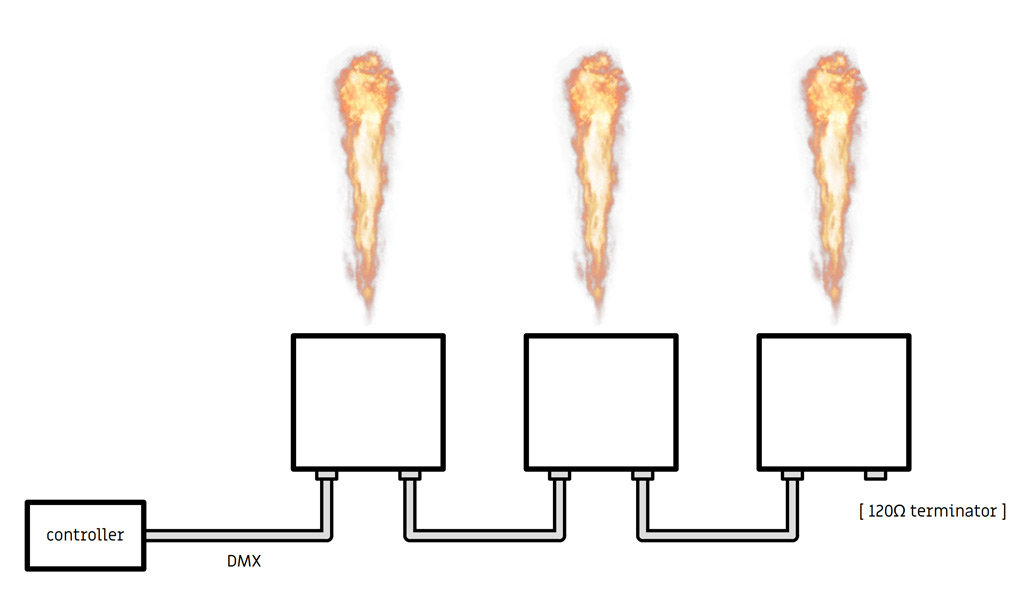
The Firewall also made an appearance at EMF2026. As part of the "Flame Village", Dimitri gave an informal talk about how the system works and showed off some of the insides. When we talk about the protocol, RS485 being a differential signal, really it's supposed to have a termination resistor at the end of the chain. You can get terminating plugs, just XLR connectors with a resistor in them, for this purpose, though Dimitri was coping without one.
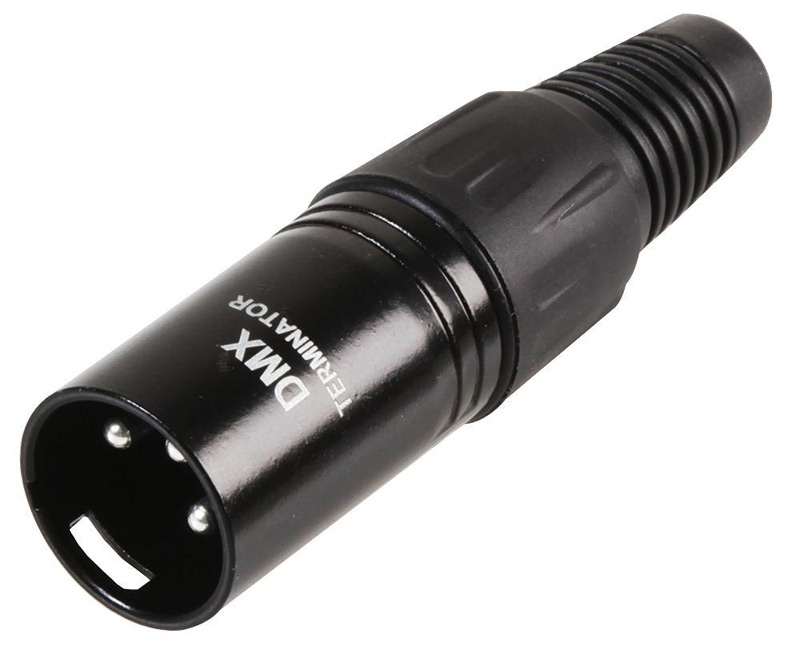
At the mention of this, Ewan, standing next to me, and being familiar with some of my work, suggested I could create something.
Just picture an XLR plug with the tiniest streak of fire squirting out of it. A cigarette lighter in DMX plug format.
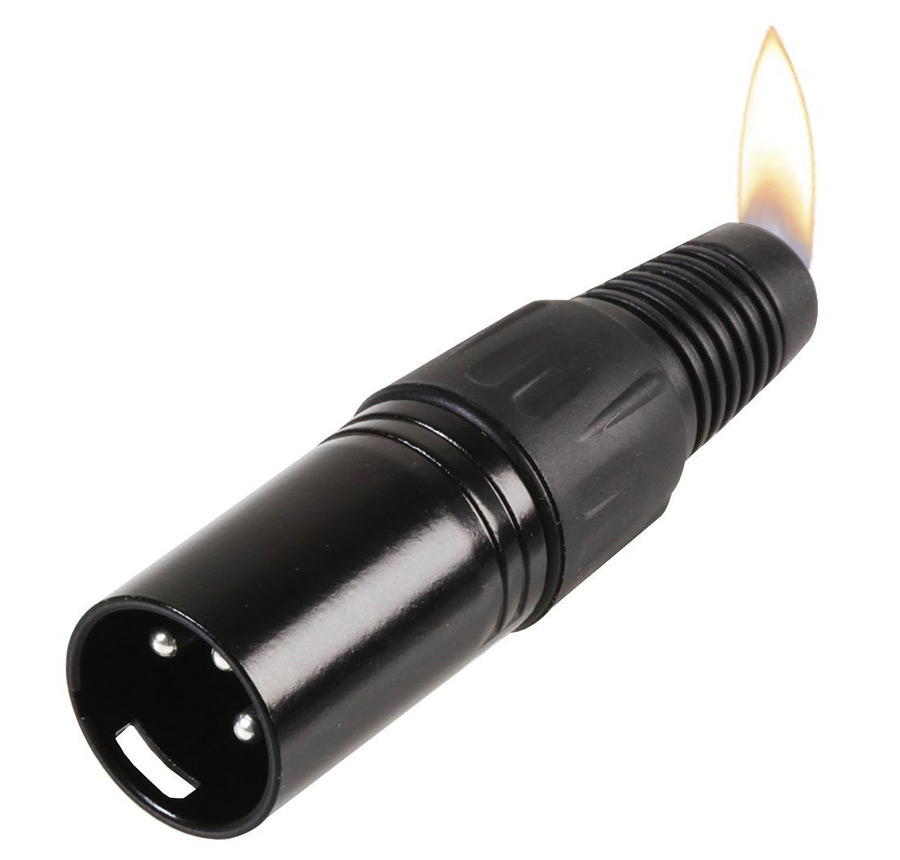
I immediately agreed that this would be hilarious and we should absolutely make it happen.
Design Considerations
Obviously the flame needs to be controlled by a DMX channel.Tempting as it is to take a regular butane lighter and squeeze it into the plug, I'm not convinced it would fit, especially when you factor in the mechanism to electrically drive it. It takes a fair amount of force to activate a piezo-ignition lighter.
Unlike MIDI cables, which use a current loop, there's no real way to leech power from the signal here, especially not in the magnitude we'd need for electromechanics. I think having a lithium battery is going to be inevitable, along with the fuel tank. And unless we can find an off-the-shelf butane lighter that fits the form factor, I think butane is going to be really inconvenient to use.
Better, probably, to miniaturise the liquid-fueled design. A tiny pouch of isopropanol with a nozzle, and a servo arm that could squeeze it. We'd need an ignition coil, something like the tiny high voltage transformers used in arc lighters. These draw a few amps, but a small LiPo can manage that.
Even the smallest servos are probably too big to use directly. The standard micro servo is the 9g model, which I've used plenty of times. Somewhat esoteric but still available are smaller servos, right down to 2g. Those measure a mere 16mm by 17mm by 8mm, if you cut off the brackets. This is still enormous compared to the room in a DMX plug. We might be able to dispense with control circuitry, and possibly the gearing. If we assembled a tiny motor with a winch, pulling fishing wire, we might be able to get enough leverage.
I suppose another option for pumping is to apply heat. A little heating coil inside the fluid container could very quickly increase the pressure. The current probably wouldn't be much worse than for the ignition coil. The uncertainty is whether we'd have enough control through this, or if we need a valve as well. And of course there's the potential for disaster putting an electric heating element inside a flammable liquid. If we're fitting a valve, then we might as well pressurise the chamber with a propellant, and then we're almost back to the butane design. It might be possible to apply fixed pressure externally to a tank of liquid fuel. A spring-loaded piston would work.
Overall I think a servo-driven piston is probably easier to build than a spring-driven piston with servo-controlled valve. Instead of a servo, very small linear actuators are available, the kind of thing that goes inside a fancy camera lens. It's unclear if these would provide enough force.
The battery, circuit, and ignition coil are going to take up a lot of space. One method to avoid a chunk of that would be to use pyrophoric fuel, a chemical that spontaneously combusts in air. Apparently the SR-71 used a pyrophoric mixture to ignite its engines. Unfortunately, pyrophoric fuels are generally very toxic, corrosive, and difficult to acquire.
Another option is flash paper. Effectively nitrocellulose in convenient squares, this is often used as a small pyrotechnic effect. It's hardly a flamethrower, but at this scale maybe that's irrelevant. I suspect even a tiny circuit would be able to provide the spark to ignite it, but we'd only have one burst of flame and be done. Perhaps a little magazine of them.